
Best 5G RedCap Low Power Router: 2026 Ultimate Guide for IoT Data Collection
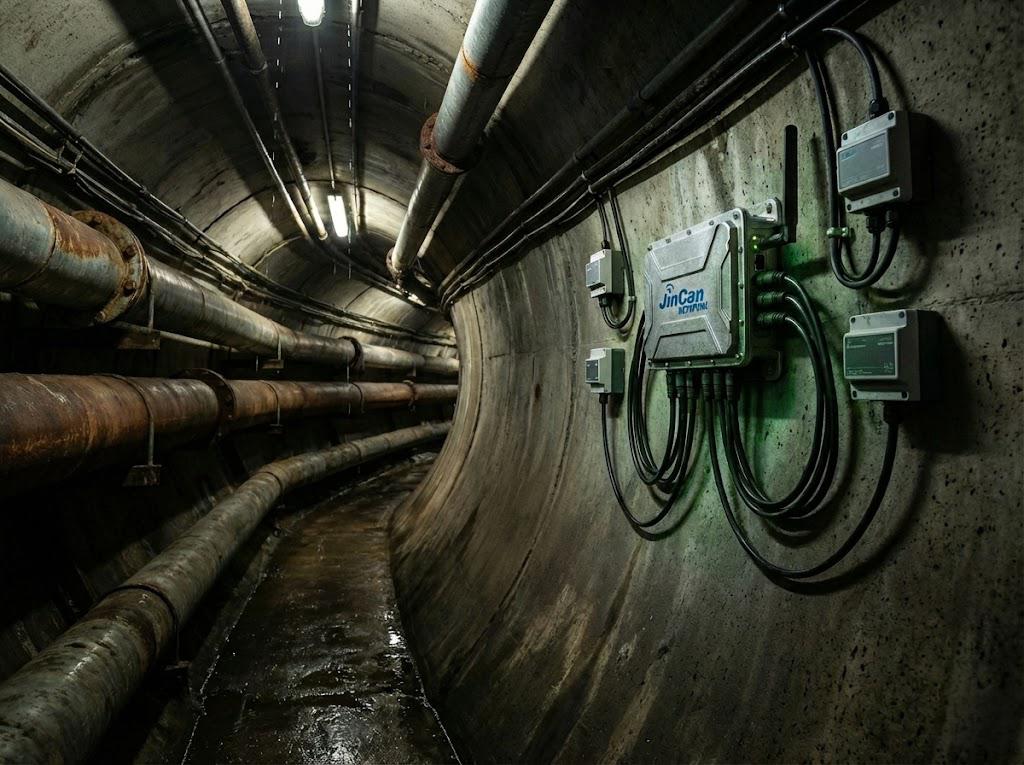
Table of Contents
- 1. What is a 5G RedCap Low Power Router?
- 2. Core Technologies: 3GPP R17 and Auto-Sleep
- 3. ZX5478 5G RedCap Low Power Router Specifications
- 4. Application: Urban Underground Utility Tunnels
- 5. Application: Water and Gas Network Telemetry
- 6. Software, Security, and VPN Features
- 7. Local Connectivity: WiFi and Diagnostics
- 8. Future of the 5G RedCap Low Power Router
1. What exactly is a 5G RedCap Low Power Router?
A 5G RedCap Low Power Router bridges the gap between high-speed but power-hungry 5G eMBB devices and low-speed LPWAN (like NB-IoT) sensors. “RedCap” stands for Reduced Capability.
This technology, standardized in 3GPP Release 17, optimizes 5G networks for mid-tier IoT devices. It provides reliable latency, moderate bandwidth, and exceptional energy efficiency.

The defining characteristic of a premium 5G RedCap Low Power Router is its ability to enter ultra-low power states. For instance, the ZX5478 model operates with a sleep mode power consumption of less than 10mW.
When data transmission is required, the router features a remote wake-up time of strictly less than 2 seconds. This makes it the ultimate solution for battery-powered or solar-powered remote data collection nodes. To understand the foundational protocols behind this efficiency, you can review the official standards published by 3GPP R17 RedCap specifications.
2. Core Technologies of the 5G RedCap Low Power Router
The architecture of a 5G RedCap Low Power Router relies on fundamental shifts in hardware and radio frequency management. Traditional 5G routers require at least four receive (RX) antennas and support up to 100MHz of bandwidth.
The RedCap standard reduces the bandwidth to 20MHz in Sub-6 GHz frequencies and simplifies the antenna configuration to 1RX or 2RX. This drastic reduction in hardware complexity directly translates to lower power consumption.
2.1 The Auto-Sleep Mechanism (< 10mW)
In low-frequency data collection scenarios—such as reading a smart water meter once every 4 hours—keeping a cellular modem active is a waste of energy. The ZX5478 5G RedCap Low Power Router utilizes a proprietary hardware auto-sleep loop.
It shuts down the main multi-core CPU, the 5G RF transceiver, and the Ethernet switch, maintaining only a microscopic watchdog circuit. In this state, the power draw drops below 10mW. This feature alone extends the battery life of remote municipal telemetry stations by up to 500% compared to traditional LTE CAT4 routers.
2.2 Rapid Remote Wake-up (< 2s)
While sleeping is easy, waking up efficiently without losing network context is technically demanding. The ZX5478 5G RedCap Low Power Router retains critical network context data in ultra-low-power SRAM.
When a remote command triggers the device, the router re-establishes the VPN tunnel and data link in less than 2 seconds. It fires the payload to the cloud and immediately returns to sleep.
3. ZX5478 5G RedCap Low Power Router Specifications
As a flagship 5G RedCap Low Power Router, the ZX5478 manufactured by Shenzhen JinCan Network encompasses industrial-grade components designed to withstand severe environmental stress.
For large-scale procurement and customized IoT topology planning, you can explore our complete ecosystem of industrial 5G routing solutions.
| Component / Feature | ZX5478 Technical Specification |
|---|---|
| Processor | Industrial-grade 32-bit dual-core communication processor (880MHz) |
| Memory / Storage | 128MB / 256MB RAM; 16MB Flash memory |
| 5G NR Frequency Bands | n1, n28, n41, n77, n78, n79 |
| 4G LTE Frequency Bands | FDD: B1, B3, B5, B7, B8; TDD: B34, B38, B39, B40, B41 |
| Physical Interfaces | 3x LAN (Gigabit), 1x WAN (Gigabit), RJ45 with lightning protection |
| Serial Interfaces | 2x RS232/485 (PIN terminal), DTU transparent transmission |
| Power Consumption | Normal mode: Standard; Sleep Mode: < 10mW; Wake-up: < 2s |
| Operating Temperature | -20°C to +75°C (Storage: -40°C to 85°C) |
| Ingress Protection | IP30 Aluminum alloy metal casing |
4. Application: Urban Underground Utility Tunnels
Urban underground utility tunnels are highly challenging RF environments. These tunnels house municipal infrastructure—power grids, communication backbones, and volatile gas pipelines—necessitating rigorous environmental monitoring.
Implementing a standard IoT network here fails due to heavy concrete signal attenuation. Deploying a 5G RedCap Low Power Router like the ZX5478 mitigates these issues effectively.
The router utilizes the 5G n28 (700 MHz) frequency band, which possesses superior penetration capabilities through soil and concrete. Inside the tunnel, arrays of Modbus RTU sensors interface directly with the router’s dual RS485 ports. The router processes this data locally and utilizes TCP/UDP transparent transmission to bypass complex protocol conversions.
Because utility tunnels often lack secondary power grids at sensor nodes, the <10mW sleep functionality of this 5G RedCap Low Power Router ensures that battery-backed monitoring stations can operate for years without human intervention. This effectively eliminates hazardous battery-replacement missions in confined spaces.
5. Application: Water and Gas Network Telemetry
Municipal water and natural gas distribution networks span thousands of square miles. The data collected from these endpoints is typically low-frequency: a water flow meter might only need to report pressure and volume statistics every six hours.
Using continuous 4G LTE connections drains power supplies rapidly. The 5G RedCap Low Power Router perfectly aligns with the operational tempo of utility telemetry. Using the auto-sleep schedule, the ZX5478 powers down entirely.
Upon waking (under 2 seconds), it executes a highly deterministic, low-latency burst transmission over the 5G Standalone (SA) core network. Furthermore, the hardware handles wide voltage inputs ranging from DC 5V to 40V.
This means the 5G RedCap Low Power Router can draw power from degrading primary cell batteries or fluctuating miniature solar arrays without crashing. It features anti-reverse connection, anti-surge, and ESD anti-static protection, making it virtually indestructible in remote outdoor cabinets.

6. Software and VPN Features of the 5G RedCap Low Power Router
A true industrial 5G RedCap Low Power Router is defined as much by its software stack as its hardware. The ZX5478 operates on an embedded real-time operating system with built-in hardware and software watchdogs.
If the network drops permanently, the watchdog executes an automated hard-reboot to restore the connection, ensuring zero downtime.
6.1 Advanced Routing Protocols
The router supports up to 253 wired LAN clients and handles complex protocols including Static IP, DHCP, PPPoE, PPTP, and L2TP. Network diagnostic tools like tcping, traceroute, dynamic domain name (DDNS), telnet, and SSH are baked into the firmware.
Crucially, the DTU (Data Terminal Unit) feature allows RS232/485 serial data to be directly encapsulated into TCP Server or Client sockets. This bridges legacy industrial logic controllers (PLCs) with modern cloud databases seamlessly.
6.2 Enterprise-Grade Cyber Security
Given the critical nature of municipal infrastructure, the 5G RedCap Low Power Router acts as a formidable firewall. It incorporates Stateful Packet Inspection (SPI) to thwart Distributed Denial of Service (DDoS) attacks targeting remote nodes.
Administrators can deploy strict MAC filtering and whitelist/blacklist controls. For secure data backhaul over public 5G networks, the device acts as both a VPN Server and Client, supporting PPTP, L2TP, and robust OpenVPN tunnels with military-grade encryption.
7. Local Connectivity: WiFi and Diagnostics
Maintenance personnel operating in the field require local access to the router without dismantling the control cabinet. The ZX5478 5G RedCap Low Power Router provides dual-band high-power WiFi coverage for localized diagnostic access.
- 2.4G WiFi Transmit Power: At channel 2412(1) utilizing 54M CHAIN0/CHAIN1, the power output exceeds 21.95 dBm, ensuring strong local signal even through metal cabinet doors.
- 5.8G WiFi Transmit Power: At channel 5180(36), the power reaches up to 21.00 dBm, providing interference-free high-speed local access for video diagnostics or massive firmware payloads.
Additionally, the physical interface features an intuitive LED diagnostic array. The SYS indicator confirms the heartbeat of the real-time OS. The NET indicator verifies successful WAN routing, and the SIG indicator displays real-time 5G signal strength. This allows technicians to adjust external SMA antenna alignments instantly.
8. Future of the 5G RedCap Low Power Router
The industrial telecommunications landscape is permanently shifting. As global carriers aggressively deprecate older 2G and 3G networks, and as standard 4G LTE-Cat4 faces obsolescence, the 5G RedCap Low Power Router stands as the ultimate future-proof investment.
By combining the low latency and massive connectivity of 3GPP R17 with extreme power conservation (<10mW sleep, <2s wake-up), the ZX5478 solves the trilemma of cost, power, and performance.
Whether securing smart grids, monitoring subterranean utility tunnels, or acting as the vital link in wide-area water telemetry, this 5G RedCap Low Power Router guarantees decades of stable, autonomous operation.

 Whatsapp+8613603031172


